





Omada Networks EAP773
Omada Networks EAP773 Tri-Band (6GHz + 5GHz + 2.4GHz) BE9300 Indoor WiFi 7 Wireless Access Point – Up To 9.3Gbps – Ceiling-Mount – 10Gbps PoE LAN Port – Supports Omada EAP Mesh & Fast Roaming

Omada Networks EAP773 Tri-Band (6GHz + 5GHz + 2.4GHz) BE9300 Indoor WiFi 7 Wireless Access Point – Up To 9.3Gbps – Ceiling-Mount – 10Gbps PoE LAN Port – Supports Omada EAP Mesh & Fast Roaming
Key Features :-
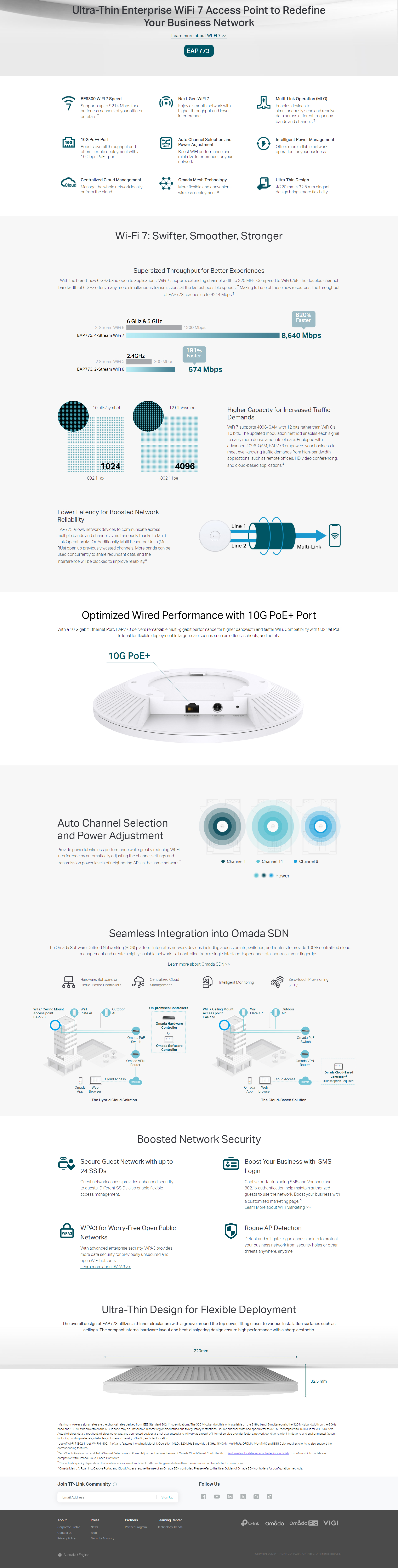
- BE9300 Tri-Band Wi-Fi 7: 5760 Mbps (6 GHz) + 2880 Mbps (5 GHz) + 574 Mbps (2.4 GHz). Buffering will no longer be a problem.†
- 1× 10G Port: Unlock the full potential of Wi-Fi 7.
- Clear 6 GHz Band: Brings cleaner and wider band resources to your Wi-Fi.
- 320 MHz Bandwidth: Up to 320 MHz bandwidth enables many more simultaneous transmissions at the fastest possible speeds.‡
- Low Latency and Interference: Multi-Link Operation, and Multi-RUs ensure high performance of your network.‡
- Advanced Functions: Supports centralized management, mesh, and AI roaming.△
- Supports Omada EAP Mesh: Allows Omada Access Points (EAPs) to connect wirelessly to each-other, extending WiFi coverage without requiring Ethernet cables for every node.
- Supports Fast Roaming: Enables wireless devices to switch between APs quickly and seamlessly also preventing connection drops during transitions ensuring a strong stanle signal.
- Note* – PoE Injector sold separately
- 5 years limited b2b warranty


| Interface | 1× 10G Ethernet Port |
|---|---|
| Button | Reset |
| Power Supply | 802.3at PoE or 12V/2.5A DC
Notice: Due to the software update, the power supply has been updated from 802.3bt to 802.3at. |
| Max. Power Consumption | • 24.05 W (For PoE); • 20.92 W (For DC) |
| Dimensions ( W x D x H ) | 8.7 × 8.7 × 1.3 in (220 × 220 × 32.5 mm) |
| Antenna | • 2.4 GHz: 2× 4.0 dBi • 5 GHz: 2× 5.0 dBi • 6 GHz: 2× 5.0 dBi |
| Bluetooth | 1 × 4.0 dBi, Bluetooth 5.2 *Firmware update may be required. |
| Mounting | Ceiling / Wall / Junction Box Mounting (Kits Included) |
| Coverage | 140㎡(1500 ft²)§ |
|---|---|
| Concurrent Clients | 380+** |
| Wireless Standards | IEEE 802.11 a/b/g/n/ac/ax/be |
| Frequency | 6 GHz, 5 GHz, and 2.4 GHz |
| Signal Rate | 574 Mbps (2.4 GHz) + 2880 Mbps (5 GHz) + 5760 Mbps (6 GHz)† |
| Wireless Functions | • MLO‡ • 4K-QAM‡ • Seamless Roaming(802.11k/v/r) • MU-MIMO (2*2 DL/UL MU-MIMO)‡ • HE320‡ • Mesh△ • BSS Coloring‡ • OFDMA‡ • Load Balance • Band Steering • Beamforming • Airtime Fairness • Multiple SSIDS:24(8 on each band) • Wireless Schedule • Reboot Schedule • QoS(WMM) • Rate Limit • Static IP/Dynamic IP • RADIUS Accounting • MAC Authentication |
| Wireless Security | • Captive Portal Authentication△ • Access Control • Maximum number of MAC Filter: 4,000 • Wireless Isolation Between Clients • VLAN • Rogue AP Detection • WPA-Personal/Enterprise, WPA2-Personal/Enterprise, WPA3-Personal/Enterprise |
| Transmission Power | < 20 dBm (2.4 GHz, EIRP) < 23 dBm (5 GHz, band 1&band 2, EIRP) < 28 dBm (5 GHz, band 3, EIRP) < 23dBm (6 GHz, EIRP) |
| Omada App | Yes |
|---|---|
| Centralized Management | • Omada Cloud-Based Controller • Omada Hardware Controller • Omada Software Controller |
| Cloud Access | Yes. Require the use of an Omada controller. |
| Email Alerts | Yes |
| LED ON/OFF Control | Yes |
| Management MAC Access Control | Yes |
| SNMP | v1, v2c, v3 |
| System Logging Local/Remote Syslog | Yes |
| Web-based Management | Yes |
| Certification | CE, FCC, RoHS, IC |
|---|---|
| Package Content | • EAP773 • Installation Guide • Ceiling/Wall/Junction Box Mounting Kits Note: Power Adapter is NOT included. |
| Environment | • Operating Temperature: 0 °C–40 °C (32 °F–104 °F); • Storage Temperature: -40 °C–70 °C (-40 °F–158 °F); • Operating Humidity: 10%–90% non-condensing; • Storage Humidity: 5%–90% non-condensing; |
How to Setup and Configure TP-Link Omada EAP Mesh
TP-Link Omada Support Articles

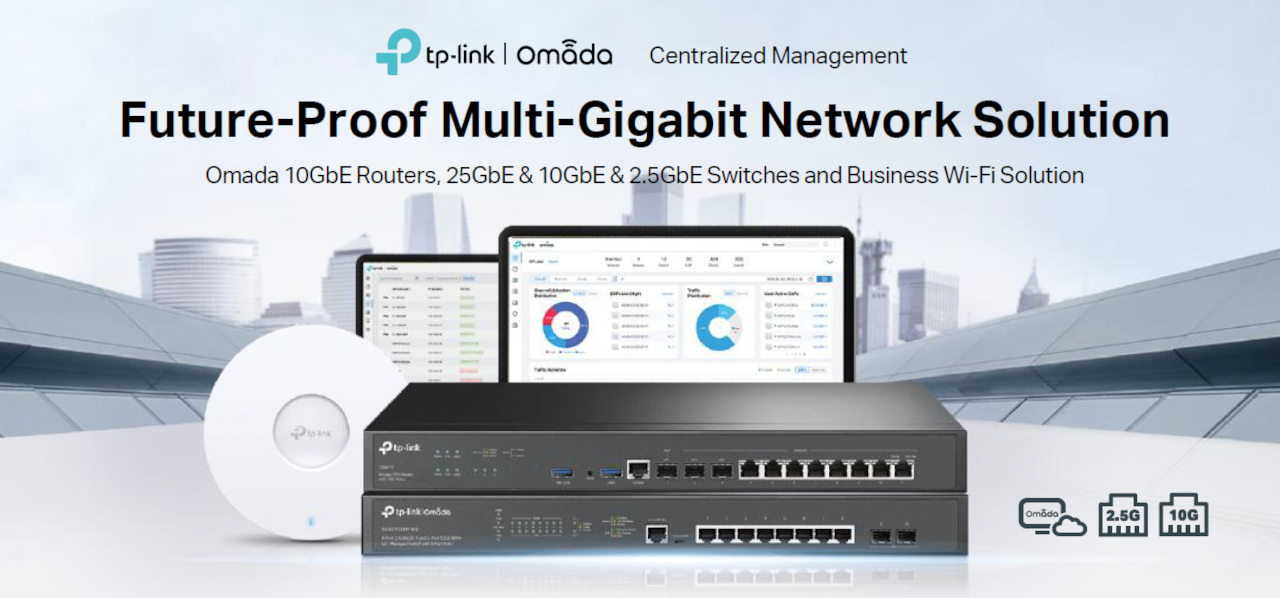
Key Reasons to Choose Omada Networks
1. Centralized Management
Omada’s Software Defined Networking (SDN) platform allows you to manage routers, switches, and wireless access points from a single dashboard instead of configuring each device separately.
2. Cloud-Based Monitoring
You can remotely monitor and manage customer sites from anywhere using the Omada cloud platform and mobile app, making it ideal for MSPs and IT providers.
3. No Ongoing License Fees
Unlike some enterprise networking brands, Omada offers cloud management without recurring per-device licensing costs, reducing long-term ownership expenses.
4. Easy Multi-Site Deployment
Zero-touch provisioning allows devices to be shipped directly to a site and automatically configured when connected to the internet. This is particularly useful for chain stores, schools, and distributed businesses.
5. Complete Ecosystem
Omada offers:
- Security gateways/routers
- Managed PoE switches
- Indoor Wi-Fi access points
- Outdoor Wi-Fi access points
- Hardware controllers
- Software controllers
All devices integrate into a single management platform.
6. Strong Wi-Fi Performance
Modern Omada access points support:
- Wi-Fi 6
- Wi-Fi 6E
- Wi-Fi 7
- Seamless roaming
- Mesh networking
- High-density client environments
This makes them suitable for offices, schools, hotels, and apartment complexes.
7. Advanced Business Features
Omada supports:
- VLANs
- Guest networks
- VPNs
- Access Control Lists (ACLs)
- 802.1X authentication
- Traffic monitoring
- QoS
- Network segmentation
These features are important for cybersecurity and network performance.
8. Excellent Value for Money
Many installers compare Omada with:
- Ubiquiti
- Grandstream
- Cisco
- Aruba
Omada generally provides similar core SMB functionality at a lower hardware cost.
For Security & IT Professionals
Since you work with surveillance and IT systems, Omada is particularly attractive because:
- PoE switches can power IP cameras, access-control devices, intercoms, and APs.
- VLANs can isolate CCTV traffic from office networks.
- Remote management reduces support visits.
- Multi-site monitoring simplifies customer support.
- High-power PoE models support modern PTZ cameras and Wi-Fi bridges.
For many New Zealand installers, Omada is often the best balance of cost, features, and manageability, especially when compared with higher-priced enterprise networking brands.
TP-Link | Omada Introduction | Omada Business Networking Solutions
TP-Link Omada Business Solutions
Omada Design Hub Network Planning Tool — Free, Easy, and Intelligent